
No Penalty CD Accounts
If you have ever wanted the higher interest rate of a certificate of deposit but hated the idea of getting hit with a fee to touch your own money, a no penalty CD is built for you. It is one of the most underrated banking products in America right now, and yet most savers have never heard of it. In simple terms, a no penalty CD accounts gives you a locked, guaranteed interest rate for a set term, but it also lets you pull your entire balance out early without paying the early withdrawal penalty that traditional CDs charge.
That single feature changes everything. It means you no longer have to choose between earning a strong yield and keeping your cash within reach. In this guide we will break down exactly how a no penalty CD works, who it is best for, where the current rates stand in 2026, and the small print you need to read before you open one.
What Is a No Penalty CD?
A no penalty CD, sometimes called a liquid CD, is a certificate of deposit that waives the usual early withdrawal penalty. With a standard CD, if you take your money out before the maturity date, the bank charges you a fee that is often equal to several months of interest. With a no penalty CD, you can withdraw the full balance early and keep every dollar of interest you have already earned, as long as you follow the bank’s rules on timing.
Like other CDs, a no penalty CD gives you a fixed annual percentage yield (APY) for the length of the term, which usually runs from about 7 months to 13 months. Because the bank is taking on more flexibility risk, the rate on a no penalty CD is sometimes a little lower than a comparable traditional CD, but it is frequently higher than a regular savings account. And just like any CD from an FDIC insured bank, your deposit is protected up to $250,000 per depositor, per ownership category.
How a No Penalty CD Actually Works
The mechanics are refreshingly simple. You open the account, deposit your money in a single lump sum, and lock in the rate. From that point forward, the bank sets one important rule: you usually cannot withdraw during the first six or seven days after funding the account. After that short window passes, you are free to withdraw the entire balance at any time, penalty free.
There is one catch worth remembering. Most banks require you to withdraw the whole balance at once rather than taking out partial amounts. If you think you may only need part of the money, the workaround is to open several smaller no penalty CDs instead of one big one, so you can break just the piece you need. This is sometimes called a mini-ladder, and it gives you even more control.
- You deposit a lump sum and lock in a fixed APY for the term.
- A short lockout period applies, usually the first 6 to 7 days after funding.
- After that, you can withdraw the full balance any time with no penalty.
- You keep all interest earned up to the day you withdraw.
- Most banks require a full withdrawal, not partial ones.
No Penalty CD vs. Traditional CD vs. High Yield Savings
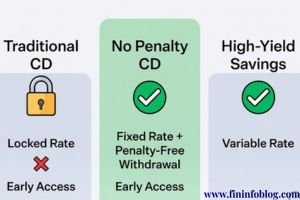
To understand why a no penalty CD is so useful, it helps to compare it to the two products it sits between. A traditional CD usually pays the highest rate, but it punishes you for early access. A high yield savings account gives you total flexibility, but its rate can drop at any time because it is variable. A no penalty CD blends the best of both: a locked rate that will not fall during your term, plus the freedom to walk away early.
When a Traditional CD Wins
If you are absolutely certain you will not need the money for the full term, a traditional CD often pays a slightly higher APY, so it can be the better math. Traditional CDs also come in much longer terms, up to five years, which lets you lock a great rate for a long time.
When a High Yield Savings Account Wins
If you want to add to your balance regularly or you may need to pull out small amounts here and there, a high yield savings account is more flexible because it allows ongoing deposits and partial withdrawals. The trade-off is that the rate can be cut whenever the bank chooses.
When a No Penalty CD Wins
A no penalty CD shines when you expect rates to fall and you want to protect a strong yield, but you are not 100 percent sure you can leave the cash untouched. It lets you lock today’s rate and still keep an escape hatch. In a falling-rate environment, that protection can be worth more than the small rate difference.
No Penalty CD Rates in 2026
As of mid-2026, the strongest CD rates from online banks and credit unions have generally been sitting in the 4.00% to 4.35% APY range for short and mid-length terms. No penalty CDs typically land a step below the very top traditional CDs, but they still comfortably beat the rock-bottom 0.01% APY that many of the biggest national banks pay on basic savings. That gap is exactly why online banks have become the go-to place for these accounts.

Rates move with the Federal Reserve, so the smart move is to compare current offers from several online banks before you commit. A rate that looks average today can look excellent six months from now if the Fed cuts rates, because your no penalty CD rate is locked while savings rates fall around it.
Who Should Open a No Penalty CD?
This product is not for everyone, but it is a perfect fit for several very common situations. Think about whether any of these describe you.
- You have an emergency fund and want it to earn more without losing access.
- You are saving for a goal 6 to 12 months away, like a wedding, move, or tax bill.
- You expect interest rates to fall and want to lock a rate before they do.
- You are nervous about tying up cash in a traditional CD but want a better yield.
- You want a predictable, FDIC insured place to park a windfall or bonus.
If, on the other hand, you truly will not touch the money for years, a longer traditional CD or a CD ladder may earn you more. And if you need to add money every payday, a high yield savings account fits better.
How to Open a No Penalty CD Step by Step
- Compare no penalty CD rates and terms from several FDIC insured online banks.
- Confirm the minimum opening deposit, since some banks require none while others ask for a set amount.
- Read the withdrawal rules, especially the early lockout window and whether partial withdrawals are allowed.
- Open the account online and fund it with a transfer from your checking or savings account.
- Set a calendar reminder for the maturity date so you can decide whether to withdraw, renew, or move the funds.
The Fine Print to Watch
Before you fall in love with a no penalty CD, read the disclosure carefully. Confirm that the account truly carries zero early withdrawal penalty, not just a reduced one. Check whether the rate is locked for the full term or only an introductory period. Verify the bank is FDIC insured, which you can do on the FDIC BankFind tool. Finally, note the maturity behavior, because many CDs renew automatically unless you tell the bank otherwise, and the renewal rate may be different from your original one.
Pros and Cons of a No Penalty CD
Like any financial product, a no penalty CD comes with trade-offs. Seeing them side by side helps you decide whether it belongs in your plan. On the plus side, you get a locked, guaranteed rate that cannot fall during your term, full early access after the short lockout window, and the same FDIC protection you would get from any insured bank. That combination is rare, because most products make you choose between a locked rate and easy access.
The downsides are modest but worth knowing. The rate is usually a touch lower than the best traditional CD of the same length, you generally must withdraw the entire balance at once, and you cannot add money after the initial deposit. For most savers, these limitations are minor compared with the flexibility a no penalty CD provides, but they explain why it is a specialized tool rather than an everyday account.
- Pro: A fixed rate that is protected even if the Federal Reserve cuts rates.
- Pro: Penalty-free access to your full balance after the first several days.
- Pro: FDIC or NCUA insurance up to $250,000 per depositor, per category.
- Con: Slightly lower yield than a comparable traditional CD.
- Con: Usually all-or-nothing withdrawals and no additional deposits.
Smart Ways to Use a No Penalty CD
The real value of a no penalty CD shows up when you match it to the right job. Because it protects a rate while keeping your money reachable, it works especially well as a bridge between spending money and long-term savings. Here are several practical ways everyday savers put these accounts to work.
First, use one to lock a strong rate right before you expect the Fed to cut. If rates fall, your yield stays put while savings accounts around you drop, and you can still break the CD if you need the cash. Second, use a no penalty CD as a higher-earning home for a portion of your emergency fund, keeping the rest in a high yield savings account for instant access. Third, park a bonus, tax refund, or home-sale proceeds there while you decide what to do next, so the money earns a guaranteed return instead of sitting idle in checking.
A fourth approach is to build a short ladder of several small no penalty CDs opened a few weeks apart. This gives you multiple locked rates and multiple exit points, so you can break just one CD at a time if a need arises. Whatever strategy you choose, the guiding principle is the same: a no penalty CD is at its best when you want the certainty of a locked rate but are not fully certain you can leave the money untouched.
Frequently Asked Questions (FAQ)
Is a no penalty CD really free to withdraw from early?
Yes. As long as you wait past the short lockout window at the start, usually six to seven days, you can withdraw the full balance of a no penalty CD with no fee and keep the interest you earned.
Are no penalty CDs FDIC insured?
When opened at an FDIC insured bank, a no penalty CD is protected up to $250,000 per depositor, per ownership category, just like any other deposit account. Credit union versions are covered by the NCUA at the same limit.
Do no penalty CDs pay less than regular CDs?
Often slightly less, because the bank gives up flexibility. But the gap is usually small, and the ability to lock a rate while keeping access can be worth more than a fraction of a percent, especially when rates are expected to fall.
Can I add more money to a no penalty CD later?
Generally no. Most CDs, including no penalty versions, are funded once with a single deposit. If you want to keep adding money, a high yield savings account or opening additional CDs is the better route.
What happens when a no penalty CD matures?
On the maturity date you can withdraw the money, move it elsewhere, or let it renew. Many banks renew automatically, so set a reminder and check the new rate before the term rolls over.
Final Thoughts
A no penalty CD is one of the simplest ways for everyday Americans to earn more on their cash without giving up control of it. It rewards you with a locked, guaranteed rate while still letting you walk away early if life happens. For emergency funds, short-term savings goals, and anyone worried about rates falling, it deserves a serious look. Compare a few FDIC insured online banks, read the withdrawal rules, and you can put your idle cash to work with confidence.