Key takeaways
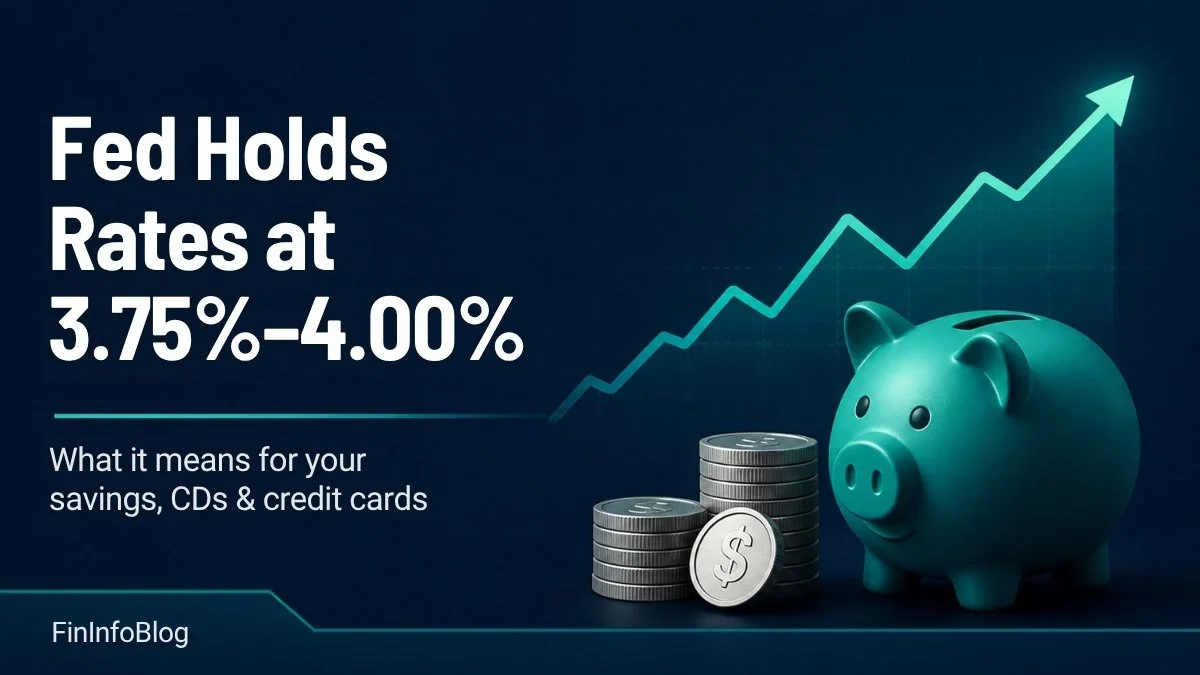
- The Federal Reserve held its benchmark rate at 3.75%–4.00% on October 28, 2026, in a 10–2 vote.
- The two dissenters, Governors Lisa Cook and Beth Hammack, wanted to raise rates right away. Nobody voted for a cut.
- Markets now see roughly an 80% chance of a hike at the December 8–9 meeting.
- For savers, that’s good news: top savings accounts pay over 4% and some CDs pay 4.6% or more. For borrowers with variable-rate debt, it’s a warning to pay down balances now.
If you were hoping for cheaper credit card rates or a dip in mortgage rates before the holidays, last week’s Fed meeting probably wasn’t what you wanted to hear.
The Fed didn’t move rates on October 28. But the more interesting part is how it didn’t move. Two of the twelve voting members wanted to raise rates by another quarter point — and not a single official argued for a cut. That tells you which direction the next move is likely to go.
Here’s what happened, why it matters, and what I’d do with my own money right now.
What the Fed actually decided
| Item | Detail |
|---|---|
| Federal funds target range | 3.75%–4.00% (unchanged) |
| Vote | 10–2 |
| Dissents | Lisa D. Cook and Beth M. Hammack, both in favor of a 0.25-point hike |
| Previous move | 0.25-point hike on September 16, 2026 |
| Prime rate | 7.00% |
| Next meeting | December 8–9, 2026 |
Chair Kevin Warsh declined to give any forward guidance, saying decisions will depend on the data. But the official statement said inflation “remains elevated” and described the economy as “expanding at a strong pace” — not the language you use when you’re about to cut.
Why the Fed is leaning toward higher, not lower
The short answer is inflation. In September, the Fed’s preferred measure (PCE prices) rose 3.6% from a year earlier, and core PCE, which strips out food and energy, was up 3.1%. The Fed’s target is 2%. Meanwhile, the economy grew at a strong 3.4% annual rate in the third quarter.
When prices are still running hot and the economy isn’t slowing down on its own, the Fed’s playbook is to keep rates high — or push them higher. In September’s projections, most officials already expected at least one more hike before the end of 2026.
What to watch: the next PCE inflation report on November 25 and the November jobs report. A hot reading makes a December hike even more likely.
What it means for your savings account
This is the bright spot. Savings rates follow the Fed, and as long as rates stay high, so do yields.
- The national average savings rate is just 0.38% (FDIC). On $10,000, that’s about $38 a year.
- Top high-yield savings accounts pay around 4.0%–4.4% APY. At 4.2%, the same $10,000 earns about $420.
If your emergency fund is still sitting at a big bank earning almost nothing, this is the easiest money you’ll make all year. Moving it takes about 10 minutes. Our guide to online banks vs. traditional banks explains how to pick a safe, FDIC-insured option.
Should you lock in a CD now?
CD rates are fixed for the term, so the question is whether you think rates will rise or fall over that period.
- Some short-term CDs are paying 4.6% or more right now — for example, an 11-month CD at 4.65% APY was among the top nationally available offers on October 29.
- On $10,000, an 11-month CD at 4.65% earns roughly $426.
- The national average 12-month CD pays only about 1.76%, so shopping around matters.
Because another hike looks likely, I wouldn’t lock up all of my savings in a long-term CD today. A smarter move is to:
- Keep your emergency fund in a high-yield savings account (its rate can rise if the Fed hikes).
- Put money you won’t need for a year into a short-term CD (6–12 months), so you can reinvest at higher rates if they keep climbing.
- Consider a no-penalty CD if you want a locked rate but might need the cash early.
What it means for credit cards
This is where higher rates hurt. Most credit cards have variable APRs tied to the prime rate, which is now 7.00%. The average APR on all credit card accounts was 21.19% in August, according to Federal Reserve data — and that was before the September hike.
A single quarter-point hike adds only about $15 a year in interest on a $6,000 balance. The real cost is the rate you’re already paying. At 21.19%, paying $200 a month on $6,000 takes about 44 months and roughly $2,620 in interest.
If you’re carrying a balance, now is the time to act:
- Move it to a 0% balance transfer card before rates go any higher.
- Or roll it into a fixed-rate debt consolidation loan, which locks your rate.
- Use the avalanche method to target your highest-rate card first.
Try your own numbers with our credit card payoff calculator.
Mortgages, HELOCs and other loans
- Mortgages: 30-year fixed rates don’t follow the Fed directly — they track the 10-year Treasury yield. They’ve hovered around 7.3% in late October. Don’t expect relief soon. Our mortgage guide covers your options.
- HELOCs: these are usually prime plus a margin, so a December hike would raise your rate within a billing cycle or two. See lines of credit explained.
- Personal and auto loans: fixed-rate loans you already have won’t change. New loans may get a little pricier, so if you’re planning to borrow, compare offers soon. Start with our list of the best personal loans.
My simple checklist for the next 30 days
- Move idle cash to a high-yield savings account paying 4% or more.
- Ladder any extra savings into short-term CDs instead of one long CD.
- Attack variable-rate credit card debt now — every month counts.
- If you have a HELOC balance, consider paying it down or switching part of it to a fixed rate.
- Hold off on big new borrowing unless you’ve compared at least three lenders.
Frequently asked questions
Did the Fed raise interest rates in October 2026?
No. The Fed held its target range at 3.75%–4.00% on October 28, 2026. Its last change was a quarter-point hike on September 16.
Will the Fed raise rates in December?
Nobody knows for sure, but futures markets priced in roughly an 80% chance of a quarter-point hike at the December 8–9 meeting after the October decision.
Will my savings account rate go up?
If the Fed hikes, many high-yield savings rates will likely rise within a few weeks. Rates at big traditional banks often barely move, which is why the account you choose matters.
Is it a good time to buy a CD?
Short-term CDs are attractive right now. With more hikes possible, many savers are choosing 6- to 12-month terms rather than locking in for several years.
Sources: Federal Reserve FOMC statement (Oct. 28, 2026); Federal Reserve G.19 consumer credit data; FDIC national rates; published CD rate tables dated Oct. 29, 2026; CME FedWatch market pricing as reported after the meeting. Rates change frequently. This article is for educational purposes and isn’t financial advice.