
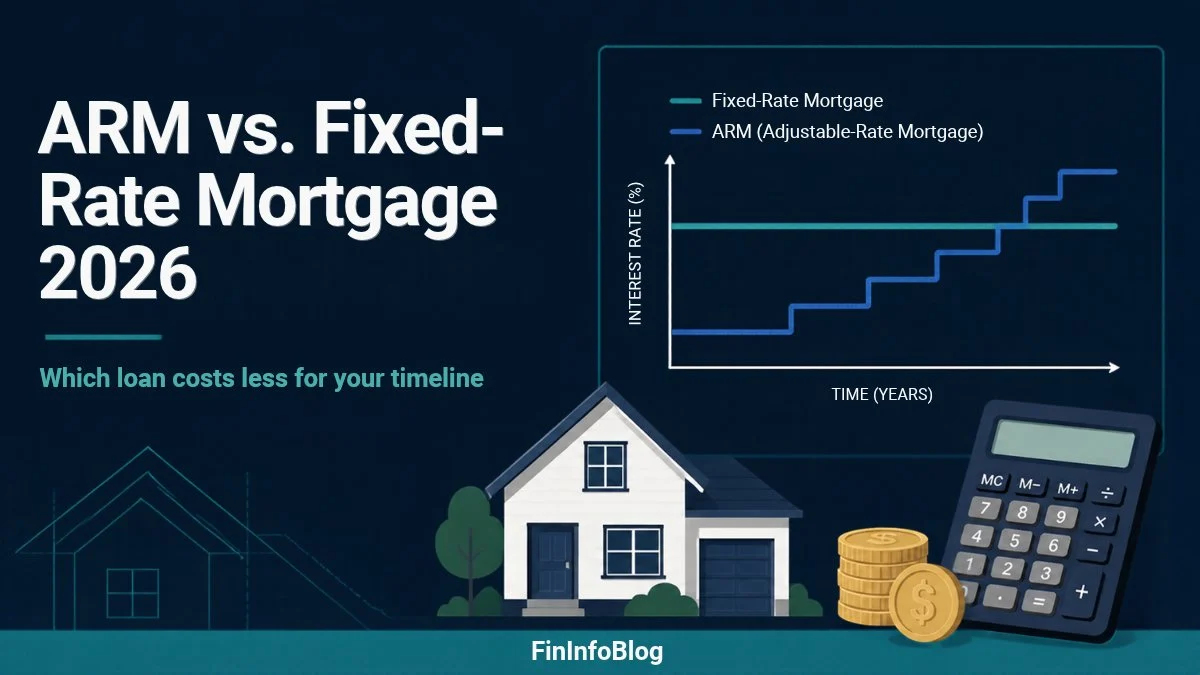
Here’s the trade in one sentence: an adjustable-rate mortgage (ARM) gives you a lower rate for the first few years, and a fixed-rate mortgage gives you a payment that never changes. On Nov. 25, 2026, Navy Federal Credit Union’s posted rates showed a 5/5 ARM at 5.875% versus 6.625% for its 30-year fixed loan. That gap saves about $171 a month on a $350,000 loan, but only for the first five years, and the rate can rise after that.
So the real question isn’t “which rate is lower today?” It’s “how long will I keep this loan, and could I afford the payment if the rate hit its cap?” This guide shows how ARMs work, runs the numbers both ways and explains who each loan fits.
Key takeaways
- An ARM’s rate after the fixed period = index + margin, limited by caps such as 2/1/5 or 5/1/5.
- In our example, the ARM stays cheaper than the fixed loan for about 8 years even if its rate rises the maximum allowed at every adjustment.
- Worst case, the same ARM’s payment could climb from $2,070 to about $3,033 a month. Qualified mortgage rules make lenders test you at the highest rate possible in the first five years.
- Fixed rates are the safer choice if you plan to stay well past the fixed period or your budget can’t absorb a payment jump.
How an adjustable-rate mortgage works
An ARM has two phases. During the initial fixed period (3, 5, 7 or 10 years), your rate doesn’t change. After that, it resets on a schedule based on a market index. The CFPB’s Consumer Handbook on Adjustable-Rate Mortgages, updated September 2026, breaks the reset rate into two parts:
- Index: a market rate the lender doesn’t control. Most new conventional ARMs use the 30-day average of SOFR (the Secured Overnight Financing Rate), published by the New York Fed. It was 3.93% on Nov. 25, 2026. Some lenders use Treasury yields instead.
- Margin: a fixed number of percentage points the lender adds, set in your loan documents. The CFPB’s example: a 3.5% index plus a 2.75% margin equals a 6.25% “fully indexed” rate.
The name tells you the schedule. A 5/6 ARM is fixed for five years, then adjusts every six months. A 7/6 ARM is fixed for seven years, then adjusts every six months. Navy Federal’s 5/5 ARM is fixed for five years and then adjusts every five years.
Rate caps: the three numbers that limit your risk
Caps are written as three numbers. The first is the most the rate can change at the first adjustment, the second is the most at each later adjustment, and the third is the most it can rise over the life of the loan. Here are the standard structures from official sources and one lender’s own disclosure:
Rates and terms checked: Nov. 25, 2026. They change often, so confirm with the provider before you apply. How we review lenders
| Loan | Index | Adjusts | Caps (first / later / lifetime) | Source |
|---|---|---|---|---|
| Fannie Mae 3/6 and 5/6 ARM | 30-day average SOFR | Every 6 months | 2 / 1 / 5 | Fannie Mae ARM plan matrix |
| Fannie Mae 7/6 and 10/6 ARM | 30-day average SOFR | Every 6 months | 5 / 1 / 5 | Fannie Mae ARM plan matrix; Chase ARM disclosure (Oct. 2026) |
| FHA 1- and 3-year ARM | 1-year Treasury or SOFR | Yearly after the fixed period | 1 per change / 5 lifetime | 24 CFR 203.49 |
| FHA 5-, 7- and 10-year ARM | 1-year Treasury or SOFR | Yearly after the fixed period | 2 per change / 6 lifetime | 24 CFR 203.49 |
| Navy Federal 3/5 and 5/5 ARM | 5-year Treasury | Every 5 years | 2 / 2 / 5 | Navy Federal ARM disclosure |
Under Fannie Mae’s rules, the lifetime cap limits only increases, and your rate can never fall below the margin. That floor matters: if rates drop sharply, an ARM can’t follow them all the way down.
Formula: Maximum rate = starting rate + lifetime cap. A 5.875% ARM with a 5-point lifetime cap can reach 10.875%. Run that rate through a mortgage calculator before you apply, not after.
ARM vs. fixed-rate mortgage: side by side
| Feature | Fixed-rate mortgage | Adjustable-rate mortgage |
|---|---|---|
| Starting rate | Higher | Usually lower during the fixed period |
| Payment | Principal and interest never change | Can rise or fall after the fixed period |
| Budget planning | Easy: same payment for 15 or 30 years | Harder: you must plan for the capped maximum |
| If rates fall | You’d need to refinance (with closing costs) to benefit | Your rate can drop at resets, but not below the margin |
| If rates rise | You’re protected | Payment rises, up to the caps |
| Qualifying | At the note rate | Often at a higher rate (see below), which can lower how much you can borrow |
| Best for | Long-term owners and tight budgets | Buyers likely to sell or refinance before the first reset |
The math: when does an ARM actually save money?
Let’s use one lender’s posted rates so the comparison is apples to apples. On Nov. 25, 2026, Navy Federal listed a 5/5 conforming ARM at 5.875% (6.603% APR, 0.25 points) and a 30-year fixed conventional loan at 6.625% (6.772% APR, 0.5 points), both assuming a 720 credit score and 30% down. That fits a $500,000 home with a $350,000 loan. (Freddie Mac’s national 30-year average was 7.28% for the week of Nov. 19, 2026, so your quotes may differ.)
| $350,000 loan, 30 years | 30-year fixed at 6.625% | 5/5 ARM at 5.875% (worst case after year 5) |
|---|---|---|
| Monthly payment, years 1–5 | $2,241.09 | $2,070.38 |
| Savings over the first 5 years | — | $10,242 in lower payments |
| Balance after 5 years | $328,106 | $325,183 (about $2,900 less) |
| Payment, years 6–10 | $2,241.09 | $2,482.95 (rate capped at 7.875%) |
| Payment, years 11–15 | $2,241.09 | $2,866.70 (9.875%) |
| Payment, years 16–30 | $2,241.09 | $3,032.72 (10.875% lifetime max) |
| Total payments over 30 years | About $806,800 | About $991,100 |
Here’s how to read it. If you sell or refinance within five years, the ARM is ahead by about $13,165 (lower payments plus a smaller remaining balance). Even in the worst case, where the rate jumps by the full 2-point cap at every reset, the ARM stays ahead through about month 100, a little over eight years. At seven years, it’s still about $5,400 ahead. By year 10, the fixed loan wins by about $6,300, and if you kept the ARM for all 30 years at the maximum rate, you’d pay roughly $184,000 more.
The worst case isn’t a forecast. Rates might rise less, stay flat or fall. But your budget has to survive the worst case, because the caps are the only promise in the contract.
Common mistake: Counting on a refinance to escape the reset. A refinance requires you to qualify again (income, credit, home value) and pay new closing costs. If home values dip or your income changes, that exit may not be there when you need it.
How lenders qualify you for an ARM
Federal ability-to-repay rules protect you from being approved only on the teaser rate. To make a qualified mortgage, a lender must underwrite the loan using the maximum interest rate that may apply during the first five years (12 CFR 1026.43). Fannie Mae’s Selling Guide spells it out by product:
- ARMs fixed for 3 years or less: qualify at the highest rate possible in the first five years.
- 5-year ARMs: qualify at the higher of the fully indexed rate or the starting rate plus the first-adjustment cap. For a 5/6 ARM with a 2-point first cap, a 5.875% start means qualifying at 7.875% or more.
- ARMs fixed longer than 5 years (7/6, 10/6): qualify at least at the starting rate, which is one reason these products can stretch your buying power more than a 5-year ARM.
That higher qualifying rate raises your debt-to-income ratio on paper, so a 5-year ARM won’t necessarily let you borrow more than a fixed loan. Check where you stand with our DTI calculator and home affordability calculator.
Who should choose an ARM, and who shouldn’t
An ARM can make sense if you:
- Expect to move within the fixed period, for example because of a job relocation or a planned move to a larger home.
- Have a clear plan to pay the loan down quickly, so less balance is exposed to future rate changes.
- Could afford the payment at the capped maximum without cutting essentials or retirement savings.
- Have a solid emergency fund to absorb a payment increase.
A fixed rate is usually better if you:
- Plan to stay in the home 10 years or more.
- Are stretching to afford the payment today.
- Have income that’s variable or likely to fall (for example, nearing retirement).
- Would lose sleep over a payment you can’t predict. Peace of mind has real value.
Practical tip: When comparing offers, ask each lender for three numbers in writing: the margin, the index, and the caps. Two ARMs with the same starting rate can have very different futures if one has a 2.75% margin and the other has 3.5%. The way we review lenders weighs those terms, not just the headline rate.
How to compare ARM and fixed quotes
- Get Loan Estimates for both products from the same lender on the same day, then repeat with two more lenders. Page 1 of an ARM Loan Estimate shows whether the rate and payment can increase and the highest they can reach.
- Compare the APR, which includes points and fees. Note the ARM’s APR is figured with assumptions about future rates, so it’s less precise than a fixed loan’s.
- Calculate the worst-case payment using the lifetime cap.
- Estimate your break-even year with the approach in the table above: how long the ARM’s early savings last against higher payments later.
- Read the ARM disclosure the lender must give you, along with the CFPB’s ARM handbook.
If you’re still at the start, our pre-approval guide and guide to mortgage types explain the steps before you choose a rate type, and how banks decide loan applications covers what underwriters weigh. FHA buyers can compare programs in FHA vs. conventional loans.
Frequently asked questions
Is an ARM a good idea in 2026?
It can be if you’re confident you’ll sell or refinance before the first reset and you could afford the capped maximum payment. With lender quotes showing ARMs well below 30-year fixed rates in late November 2026, the early savings are meaningful. But no one can predict rates five or seven years out, so the decision should rest on your timeline and budget, not a rate forecast.
What does 5/6 ARM mean?
A 5/6 ARM has a fixed rate for the first five years, then adjusts every six months for the rest of the loan. Under Fannie Mae’s standard terms, it’s tied to the 30-day average SOFR and usually has 2/1/5 caps: up to 2 points at the first change, 1 point at each later change, and 5 points over the life of the loan.
Can an ARM rate go down?
Yes. If the index falls, your rate can drop at a scheduled adjustment, limited by the per-adjustment cap. It can’t fall below the margin, though, so you won’t capture the full decline in market rates.
How much can my ARM payment go up?
Your loan’s caps set the limit. Take your starting rate plus the lifetime cap to find the highest possible rate, then calculate the payment on your remaining balance. In our $350,000 example, a 5.875% ARM with a 5-point lifetime cap could reach 10.875%, raising principal and interest from about $2,070 to about $3,033 a month.
Can I refinance an ARM into a fixed-rate mortgage?
Yes, as long as you qualify for the new loan when you apply. You’ll go through underwriting again and pay closing costs, and the fixed rates available then may be higher or lower than today’s. Planning to refinance is fine as a backup, but don’t make it your only plan.
Sources: CFPB Consumer Handbook on Adjustable-Rate Mortgages (Sept. 2026); 12 CFR 1026.43 (ability-to-repay/qualified mortgage) and 24 CFR 203.49 (FHA ARMs) via eCFR; Fannie Mae Standard ARM Plan Matrix and Selling Guide B2-1.4-02 (Dec. 10, 2025) and B3-6-04; Chase ARM program disclosure (Oct. 2026); Navy Federal Credit Union mortgage rates (as of Nov. 25, 2026; 720 FICO, 30% down, single-family primary home) and ARM disclosure; New York Fed 30-day average SOFR (Nov. 25, 2026); Freddie Mac PMMS (week of Nov. 19, 2026). Payment and break-even calculations by FinInfoBlog; the worst case assumes the maximum increase at every adjustment. Rates and terms checked Nov. 25, 2026. This article is for educational purposes and isn’t financial advice.

Written by Chanchala
Founder & Lead Writer · B.Sc. Mathematics (Honors) · 9 years in banking & lending
Chanchala is the founder and lead writer of FinInfoBlog. She holds a B.Sc. in Mathematics (Honors) and has 9 years of experience in banking and lending. She writes plain-English guides on savings, CDs, loans, credit and personal finance for U.S. readers, and makes sure every example shows the math behind the money decision. How we research and fact-check.