
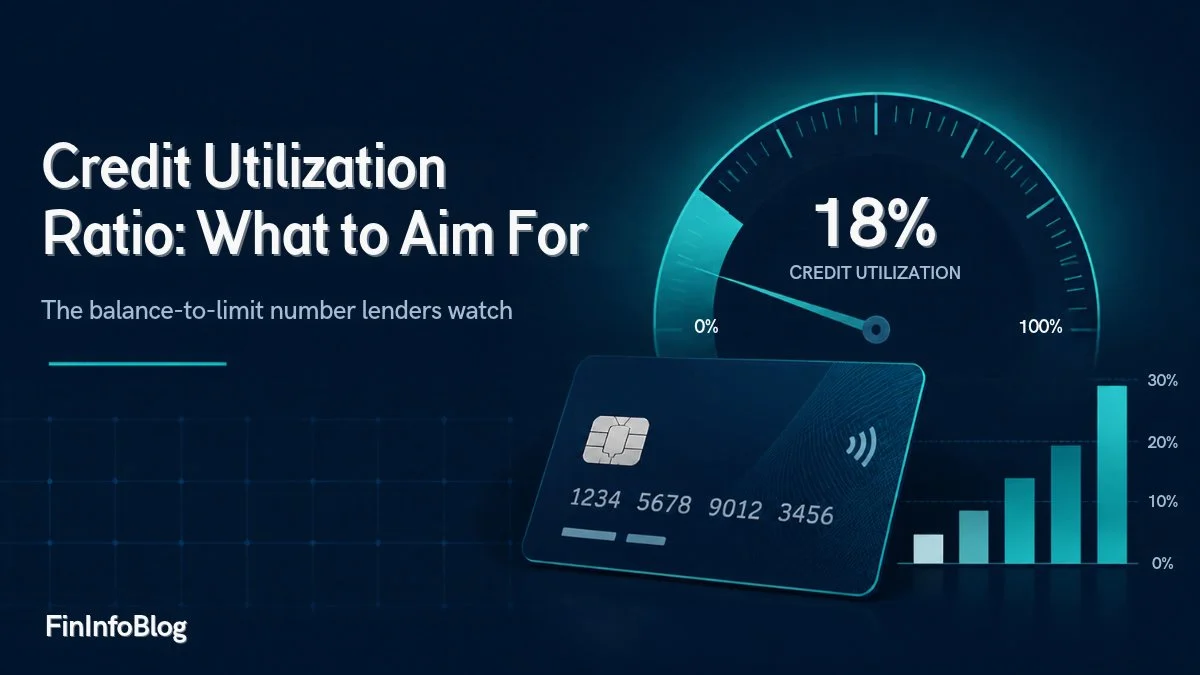
Short answer: keep your credit utilization ratio under 30% at the very least, and under 10% if you want the best scores. Experian’s data shows that people with 800–850 FICO Scores use about 7% of their available credit on average, and FICO says people with a perfect 850 average about 4.1%. A small balance, such as 1% to 9%, usually scores a little better than 0%.
Key takeaways
- Utilization falls under “amounts owed,” which FICO says counts for about 30% of a typical FICO Score.
- Average utilization runs from 7.1% for exceptional scores to 80.7% for poor scores (Experian, Q3 2024 data).
- Scores look at your overall ratio and each card. One maxed-out card can hurt even when the total looks fine.
- Most scores only see your latest reported balance, so paying down before the statement closes can lift your score within a month or two.
Your credit utilization ratio is the share of your revolving credit limits you’re using. It changes every month, which makes it the fastest credit score factor you can move. Payment history takes years to build. Utilization can improve as soon as your card issuers send new balances to the bureaus.
This guide covers what ratio to aim for, how lenders and scoring models read it, and how to lower it without hurting your score in other ways. It’s part of our series on how banks decide loan applications.
What is a credit utilization ratio?
It’s your revolving balances divided by your revolving credit limits. Revolving accounts are ones you can borrow from again and again, like credit cards, personal lines of credit and HELOCs. Car loans, mortgages and student loans are installment loans, so they don’t count here. Scoring models look at those balances in a different way.
The formula is simple:
Formula: utilization = total revolving balances ÷ total revolving credit limits × 100. A $2,000 balance on $10,000 of total limits is 20%.
Two details trip people up:
- The balance comes from your credit report, not your app. Issuers usually send the balance from your monthly statement. So even if you pay in full every month, your report can show a balance.
- Closed cards can still count. FICO says a closed revolving account with a balance stays in the math until it’s reported at $0. After that it drops out, along with its credit limit.
Want to skip the arithmetic? Enter your cards in our credit utilization calculator to see your overall and per-card ratios.
What credit utilization ratio should you aim for?
There’s no magic cutoff. FICO says plainly that “the 30% point doesn’t determine who has good or bad credit.” Still, the data show a clear pattern. Experian found that U.S. consumers averaged 29% utilization in Q3 2024. The averages by FICO Score range showed a steep slope:
| FICO Score range | Average credit card utilization | What it suggests |
|---|---|---|
| Exceptional (800–850) | 7.1% | Single digits are normal at the top |
| Very good (740–799) | 15.2% | Low teens still score well |
| Good (670–739) | 38.6% | Above 30%, which is often where the drag gets stronger |
| Fair (580–669) | 61.4% | High balances plus other problems, often late payments |
| Poor (300–579) | 80.7% | Cards close to maxed out |
Source: Experian, average credit card utilization by FICO Score range, Q3 2024 data (published Oct. 9, 2025). Experian’s Aug. 24, 2026 report on June 2026 data put the 800–850 average at 7%, similar to earlier years.
Those numbers translate into practical targets:
- Under 30%: the minimum to aim for. Experian calls 30% the point where utilization starts to have a stronger negative effect.
- Under 10%: the target if you’re about to apply for a mortgage, auto loan or a premium card.
- 1% to 9%, not 0%: FICO and Experian both say low utilization can score better than none at all. A score needs some active use to judge.
Keep in mind that this table shows correlation, not cause. People with 800 scores also tend to have long, spotless payment histories. Getting to 7% utilization won’t give you an 800 score on its own. It just removes one of the biggest drags.
Overall vs. per-card utilization: both count
FICO says its scores look at your overall rate and also at the highest rates on individual revolving accounts. This is where many people with “low” total utilization lose points.
Here’s a worked example with three cards:
| Card | Limit | Statement balance | Card utilization |
|---|---|---|---|
| Card A | $5,000 | $1,200 | 24% |
| Card B | $3,000 | $1,800 | 60% |
| Card C | $2,000 | $0 | 0% |
| Total | $10,000 | $3,000 | 30% overall |
Overall, this person sits at 30%, which is borderline. Card B at 60% is the real problem. Paying $1,200 on Card B before its statement closes drops it to 20% ($600 of $3,000) and brings overall utilization to 18% ($1,800 of $10,000). To reach the under-10% target, total reported balances need to be $900 or less.
If you only have extra cash for one card, pay down the one with the highest ratio first. If your goal is saving interest, pay the highest APR first. For a quick credit-score boost before an application, start with the highest ratio.
Does credit utilization have a “memory”?
For most scores in use today, it doesn’t. Experian says most models look only at the balances and limits most recently reported. Run up a big balance in March, pay it off in April, and your score usually recovers once the lower balance shows up.
Newer models are starting to change that. VantageScore 4.0 and FICO Score 10 T use trended data, which tracks your balances and utilization over many months, not just one snapshot. Under these models, someone who pays down balances steadily can look better than someone who carries high balances month after month. Lenders are adopting these models slowly. Even so, it’s a good reason to keep balances low all the time, not just in the month before you apply.
How to lower your credit utilization ratio
1. Pay before the statement closing date
This is the quickest fix, and it costs nothing. Your issuer usually reports the balance on your statement, and your due date comes a few weeks later. Say you charge $2,500 a month on $10,000 of limits and pay in full by the due date. Your report still shows 25%. Pay $1,800 a few days before the statement closes, and only $700 gets reported, or 7%. You’ll find the closing date on your statement or in your card’s app.
2. Make two payments a month
If you put big expenses on a card for rewards, pay once mid-cycle and once by the due date. You keep the rewards, and the reported balance stays low.
3. Pay down balances you carry
This one pays off twice. Cutting the balance lowers utilization and saves interest. At the Federal Reserve’s Q3 2026 average of 22.36% on accounts charged interest, a $3,000 balance costs about $56 a month in interest. Our credit card payoff calculator shows how fast extra payments cut both the balance and the interest.
4. Ask for a higher credit limit, carefully
A higher limit with the same balance lowers your ratio. Ask your issuer whether the request needs a hard credit check. Some issuers do one and some don’t, and a hard inquiry usually costs fewer than 5 points under FICO. Only ask if you’re sure the extra room won’t tempt you to spend more.
5. Keep old, paid-off cards open
Closing a card takes away its limit. In the example above, closing the $5,000 card after moving its balance would leave $3,000 owed on $5,000 of limits, which is 60%. If an old card has no annual fee, use it for a small recurring bill and set up autopay so it stays active.
6. Consider a consolidation loan, but know the trade-off
Moving card debt to a personal loan turns revolving debt into installment debt, which usually lowers utilization. It only helps if the loan’s APR is lower and you don’t run the cards back up. Compare the numbers in our personal loan vs. credit card guide before you apply.
From the lending desk: In our team’s experience reviewing loan files, high utilization is the score problem applicants can fix the fastest, and the one they most often leave until it’s too late. A mortgage or auto underwriter sees the balances your issuers reported last month. If you pay a card down the day before you apply, the report may not show it yet. Pay balances down at least one full statement cycle before you apply. If you’re already in the mortgage process, ask your loan officer whether a rapid rescore makes sense. Keep the payment confirmations, because lenders often ask where large payments came from and may match them against your bank statements.
Common utilization mistakes
- Thinking paying in full means 0% reported. It usually doesn’t. Timing is what controls the reported balance.
- Closing cards right before applying for a loan. You lose limit and can push your ratio up just when it matters most.
- Letting one card run near its limit. The per-card ratio counts even if your other cards are empty.
- Making big purchases before a mortgage closes. Furniture or appliances charged before closing can raise your utilization and your DTI. Lenders may pull credit again before closing.
- Paying everything to exactly $0 right before you apply. A small reported balance, such as 1% to 9% on one card, usually scores a little better.
How utilization fits into a lender’s decision
Your score is just the start. Lenders also look at your debt-to-income ratio, and card minimum payments are part of it. So a high card balance can hurt twice: once through your score and again through your monthly obligations. Check your numbers with our DTI calculator. To see how score bands translate into the rates lenders actually offer, read how credit scores affect loan approval and rates.
If your report shows a balance or limit that’s wrong, dispute it with the bureau. A wrong limit, such as $0 or a limit lower than your real one, can make your ratio look much worse than it is. Our free credit report dispute letter tool helps you write the request.
Next steps: pull your free reports at AnnualCreditReport.com, write down each card’s limit and reported balance, find your statement closing dates, and set a reminder to pay down balances a few days before each one closes.
Frequently asked questions
What is a good credit utilization ratio?
Under 30% is acceptable, and under 10% is better. People with 800-plus FICO Scores average about 7%, according to Experian. Keeping a small balance, such as 1% to 9%, usually scores a little better than reporting 0% on every card.
Is 0% credit utilization bad for my credit score?
It’s not bad, but it’s usually not the best. FICO and Experian both say a low utilization rate can help more than not using any credit. If every card reports $0, your score has less recent activity to go on. Letting one card report a small balance and paying it in full avoids interest.
How fast does my credit score go up after I pay down my credit cards?
Often within one or two statement cycles. Most scoring models use only the latest reported balances, so the improvement shows up once your issuer reports the lower balance, usually around your statement date. Newer models that use trended data, such as VantageScore 4.0 and FICO 10 T, also look at your balances over time.
Does credit utilization include loans like my car loan or mortgage?
No. The utilization ratio covers revolving accounts like credit cards, lines of credit and HELOCs. FICO looks at installment loans separately, by comparing the remaining balance to the original loan amount.
Should I pay my credit card before the statement date or the due date?
Pay by the due date to avoid interest and late fees. If you also want lower reported utilization, make a payment a few days before the statement closing date. Many people do both: a large payment before the statement closes and the rest by the due date.
Related guides: How to improve your credit score · Credit card mistakes to avoid · Balance transfer credit cards · Missed a loan payment?
Sources: myFICO, “Credit Utilization Ratio: How It Affects Scores” (updated Nov. 2, 2026) and “How Owing Money Can Impact Your Credit Score”; Experian, “What Is a Credit Utilization Rate?” (Oct. 9, 2025; Q3 2024 data) and “How Many Americans Have an 800 Credit Score?” (Aug. 24, 2026; June 2026 data); Federal Reserve G.19 Consumer Credit release (Q3 2026 card rate on accounts assessed interest). Checked Nov. 16, 2026. This article is for educational purposes and isn’t financial advice.

Written by Chanchala
Founder & Lead Writer · B.Sc. Mathematics (Honors) · 9 years in banking & lending
Chanchala is the founder and lead writer of FinInfoBlog. She holds a B.Sc. in Mathematics (Honors) and has 9 years of experience in banking and lending. She writes plain-English guides on savings, CDs, loans, credit and personal finance for U.S. readers, and makes sure every example shows the math behind the money decision. How we research and fact-check.