
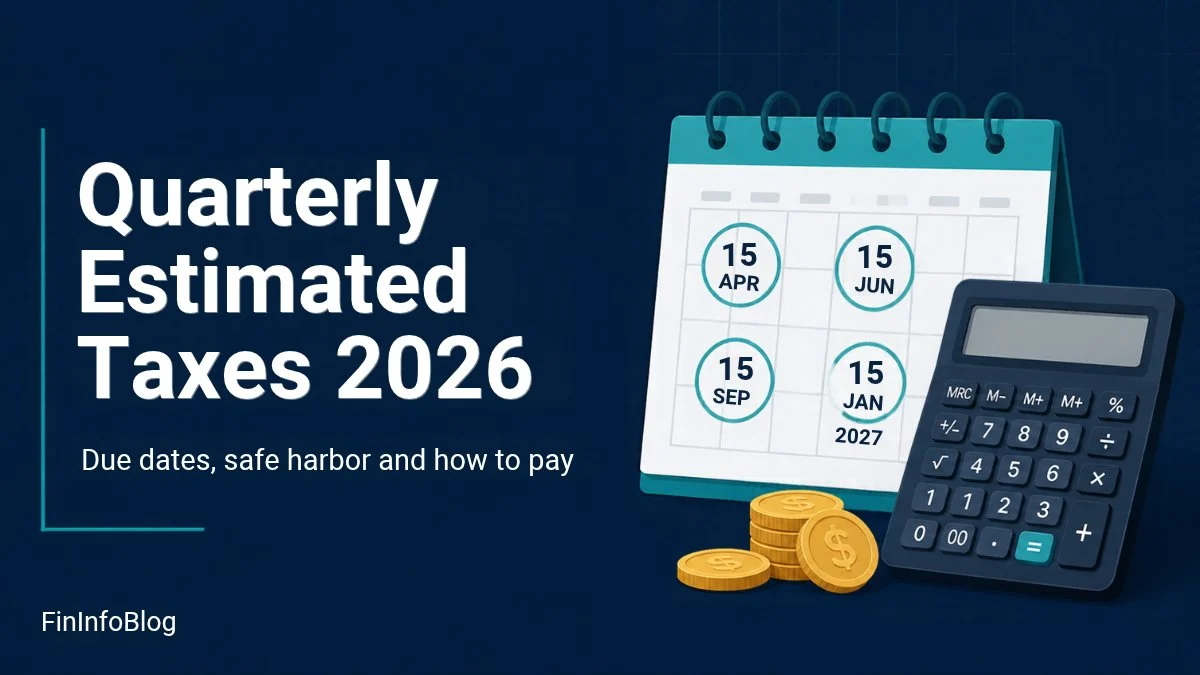
If you earn money that no one withholds tax from, such as freelance pay, side-hustle income, rental income or big investment gains, the IRS expects you to pay as you go. That’s what quarterly estimated taxes are. You generally have to pay them if you expect to owe at least $1,000 in federal tax for 2026 after withholding and refundable credits. The last 2026 payment is due Jan. 15, 2027.
Here’s the full schedule for tax year 2026, straight from the IRS’s Form 1040-ES:
| Payment | Income earned | Due date |
|---|---|---|
| 1st | Jan. 1 – March 31, 2026 | April 15, 2026 (Wednesday) |
| 2nd | April 1 – May 31, 2026 | June 15, 2026 (Monday) |
| 3rd | June 1 – Aug. 31, 2026 | Sept. 15, 2026 (Tuesday) |
| 4th | Sept. 1 – Dec. 31, 2026 | Jan. 15, 2027 (Friday) |
Notice the “quarters” aren’t equal. The second one covers only two months, and the fourth covers four. If a due date lands on a weekend or legal holiday, the IRS treats a payment made on the next business day as on time.
Key takeaways
- You generally owe estimated tax if you expect to owe $1,000 or more after withholding and refundable credits.
- You avoid the underpayment penalty if you pay at least 90% of your 2026 tax or 100% of your 2025 tax (110% if your 2025 AGI was over $150,000).
- The penalty works like interest. The IRS rate for individuals is 7% a year for the fourth quarter of 2026.
- IRS Direct Pay and EFTPS let you pay from a bank account at no cost. Card payments carry a processor fee.
Who has to pay estimated taxes?
The IRS test has two parts. You need to make estimated payments for 2026 if both of these are true:
- You expect to owe at least $1,000 in federal tax for 2026 after subtracting withholding and refundable credits.
- Your withholding and refundable credits will be less than the smaller of 90% of your 2026 tax or 100% of your 2025 tax (110% for higher earners, explained below).
In practice, the people who usually need to pay are:
- Freelancers, gig workers and independent contractors paid on a 1099. Nobody withholds income tax or Social Security and Medicare tax from that pay.
- Sole proprietors and single-member LLC owners. If you formed an LLC recently, our guide on how to start an LLC explains how the IRS taxes it by default.
- Landlords with rental profit.
- Investors with large capital gains, dividends or interest. Our capital gains tax calculator helps you size that part.
- W-2 employees with side income, if their paycheck withholding doesn’t cover the extra tax.
There’s one clean exception. You don’t have to pay estimated tax for 2026 if you were a U.S. citizen or resident alien for all of 2025 and had no tax liability for the full 12-month 2025 tax year.
Safe harbor rules: how to avoid the penalty
You don’t need to predict your tax to the dollar. The IRS gives you “safe harbor” targets. Pay at least the smaller of these two amounts on time, through withholding and estimated payments combined, and you won’t owe an underpayment penalty, even if you still owe a balance in April:
| Safe harbor | Who it fits | Watch out for |
|---|---|---|
| 90% of your 2026 tax | People whose income dropped this year | You have to estimate the current year accurately |
| 100% of your 2025 tax | People whose income is rising | Your 2025 return must cover all 12 months |
| 110% of your 2025 tax | Anyone whose 2025 AGI was over $150,000 ($75,000 married filing separately) | Replaces the 100% test for higher earners |
Farmers and fishermen get a looser rule. If at least two-thirds of your gross income for 2025 or 2026 comes from farming or fishing, the 90% test becomes 66⅔%. You can either pay all your 2026 estimated tax by Jan. 15, 2027, or file your 2026 return and pay everything you owe by March 1, 2027.
Practical tip: If your income is growing, the prior-year rule is the easiest way to sleep at night. Find “total tax” on your 2025 Form 1040, divide by four (multiply by 1.1 first if your AGI was over $150,000), and pay that amount each quarter. Then set aside the extra you’ll owe in April in a separate high-yield savings account so it earns interest until the deadline.
How to calculate your quarterly payment: a worked example
Let’s walk through a simple case. Dana is a single freelance designer. She expects $80,000 of net profit (income minus business expenses) in 2026, has no other income and takes the standard deduction.
| Step | How it works | Amount |
|---|---|---|
| 1. Self-employment tax | $80,000 × 92.35% × 15.3% | $11,303.64 |
| 2. Deduct half of SE tax | $11,303.64 ÷ 2 | −$5,651.82 |
| 3. Adjusted gross income | $80,000 − $5,651.82 | $74,348.18 |
| 4. Standard deduction (single, 2026) | −$16,100 | |
| 5. Qualified business income deduction | 20% of $58,248.18 (the smaller of the two QBI limits here) | −$11,649.64 |
| 6. Taxable income | $46,598.54 | |
| 7. Income tax (2026 single brackets) | $1,240 + 12% of the amount over $12,400 | $5,343.83 |
| 8. Total 2026 federal tax | Income tax + SE tax | $16,647.47 |
| Quarterly payment | Total ÷ 4 | about $4,162 |
A few notes on the math. The 15.3% self-employment tax is 12.4% for Social Security plus 2.9% for Medicare, and you apply it to 92.35% of net profit, as the Form 1040-ES instructions say. The Social Security part stops at the 2026 wage base of $184,500, so very high earners pay less than 15.3% on income above that. The QBI deduction, which the 2025 tax law made permanent, is the smaller of 20% of qualified business income or 20% of taxable income before the deduction. For Dana, the second limit is lower.
Now the safe harbor shortcut. Say Dana’s 2025 return showed $12,000 of total tax and her AGI was under $150,000. If she pays $3,000 each quarter, she’s covered 100% of last year’s tax and owes no penalty. She’d still owe the remaining $4,647 or so by April 15, 2027, so she should save it as the year goes on.
Want to run your own figures? Use our self-employment tax calculator for the 15.3% part and the income tax calculator for the rest. The brackets themselves are in our 2026 tax brackets guide.
Good to know: The 2026 Form 1040-ES worksheet also reflects the new deductions for tips, overtime, car loan interest and seniors, which are claimed on Schedule 1-A. If any of them apply to you, they lower the tax you need to estimate. Our guide to no tax on tips and the other Schedule 1-A deductions covers the limits.
Uneven income? Use the annualized method
Paying four equal amounts assumes you earn money evenly. Plenty of people don’t. A wedding photographer may earn most of her income from May to October. An investor might sell a big position in December.
The IRS lets you match payments to when you actually earn the money through the annualized income installment method. It can lower or eliminate the required payment for earlier periods when your income was low. The worksheet is in chapter 2 of IRS Publication 505. If you use it, you must attach Form 2210, including Schedule AI, to your 2026 return, even if you owe no penalty.
It’s more paperwork, but it can save real money if your income arrives late in the year.
How to pay estimated taxes
The IRS accepts several methods. The free ones are usually the best choice:
| Method | Cost | Best for |
|---|---|---|
| IRS Online Account | Free | Seeing past payments and paying in one place |
| IRS Direct Pay (from a checking or savings account) | Free | Quick one-off payments without enrolling |
| EFTPS | Free, but you must enroll first | Scheduling all four payments in advance |
| Debit card, credit card or digital wallet | Processor fee | Only if you truly need the card |
| Check or money order with a 1040-ES voucher | Postage | People who prefer paper |
| Cash at a retail partner | Retailer fee | People without a bank account (never mail cash) |
If you pay by check, make it payable to “United States Treasury,” write your SSN and “2026 Form 1040-ES” on it and mail it with the voucher to the address listed for your state. A U.S. postmark dated on or before the due date counts as on time. The IRS doesn’t accept digital assets as payment.
Common mistake: Paying through a business checking account and forgetting to label it as an individual 1040-ES payment for the right tax year. Choose “Estimated tax” and “2026” carefully in Direct Pay or EFTPS. A payment applied to the wrong year is a hassle to fix. Keeping a separate business checking account for income and a separate savings bucket for taxes makes the record clean.
What the underpayment penalty actually costs
The penalty isn’t a flat fine. It’s figured separately for each installment, based on how much you underpaid and how many days late the money was, at the IRS underpayment rate. For individuals, that rate is 7% a year for the quarter that began Oct. 1, 2026. The IRS sets it each quarter and hadn’t announced the rate for early 2027 as of Nov. 23, 2026.
Example: you were $4,000 short on the Sept. 15, 2026, payment and caught up on Jan. 15, 2027. That’s 122 days. At 7% a year, the penalty works out to roughly $94 ($4,000 × 7% × 122 ÷ 365), assuming the rate stays at 7%.
That’s not a disaster, but it’s money you don’t need to give away. And the cost keeps growing for every installment you skip until you file.
Withholding can do the job instead
If you also have a W-2 job, you may not need to send quarterly payments at all. You can raise the federal withholding on your paycheck with a new Form W-4 so that it covers the tax on your side income. Withholding is generally treated as paid evenly through the year, even if you increase it in December, which makes it a handy fix if you fell behind. Check your new paycheck amount with our take-home pay calculator.
And one shortcut for the final payment: you don’t have to make the Jan. 15, 2027, payment if you file your 2026 return by Feb. 1, 2027, and pay the entire balance with it.
Your next steps
- Pull your 2025 Form 1040 and note your total tax and AGI.
- Decide which safe harbor to use: 100% (or 110%) of last year, or 90% of this year.
- Estimate 2026 tax with the steps above or the Form 1040-ES worksheet.
- If you missed earlier 2026 payments, pay what you can now. Less time late means a smaller penalty.
- Schedule the Jan. 15, 2027, payment in Direct Pay or EFTPS today.
- Move 25% to 30% of each new client payment into a tax savings account. It isn’t an IRS rule, just a buffer, so adjust it to your own estimate.
For more ways to trim your 2026 bill before Dec. 31, see our year-end tax planning guide. If you’re just starting freelance work, our side hustle guide and our roundup of invoicing and payroll software help you track income from day one. When refund season arrives, our tax refund timeline shows what to expect.
Frequently asked questions
When are quarterly estimated taxes due for 2026?
April 15, 2026; June 15, 2026; Sept. 15, 2026; and Jan. 15, 2027. If a date falls on a weekend or legal holiday, a payment made the next business day counts as on time.
Do I have to pay estimated taxes if I only made a little money from a side hustle?
Not necessarily. The rule kicks in when you expect to owe $1,000 or more after withholding and refundable credits. Even then, you can skip quarterly payments if your paycheck withholding already covers 90% of this year’s tax or 100% (110% for higher earners) of last year’s. Remember that side-hustle profit of $400 or more generally triggers self-employment tax too.
What happens if I miss a quarterly estimated tax payment?
The IRS may charge an underpayment penalty, figured like interest on the amount you were short for the days it was late. The rate is 7% a year for the fourth quarter of 2026. Pay as soon as you can to stop it from growing, and check Form 2210 when you file. The penalty may be waived in some cases, for example after a casualty or disaster, or if you retired after age 62 or became disabled in 2025 or 2026 and the shortfall had a reasonable cause.
Can I pay all my estimated taxes at once?
Yes. Form 1040-ES says you can pay all of your 2026 estimated tax by April 15, 2026, or in four equal amounts. Paying late in a lump sum doesn’t erase penalties on earlier quarters you missed, though.
How much should a freelancer set aside for taxes?
It depends on your income, deductions and state. In our example, a single freelancer with $80,000 of profit owes about $16,650 in federal tax, about 21% of profit, before any state income tax. Many people save 25% to 30% of each payment as a cushion and adjust once they’ve run the 1040-ES worksheet.
Updated Nov. 23, 2026. Sources: IRS Form 1040-ES (2026), including due dates, safe harbor rules, the 92.35% factor, the $184,500 Social Security wage base and payment options; IRS “Estimated tax” FAQs (last reviewed Oct. 16, 2026); IRS Publication 505 (2026); IRS news release IR-2026-98 (Aug. 21, 2026) and the IRS quarterly interest rates page (7% for Oct. 1, 2026); Social Security Administration contribution and benefit base table; IRS Rev. Proc. 2025-32 (2026 brackets and standard deduction). Calculations by FinInfoBlog. This article is for educational purposes and isn’t tax advice.

Written by Chanchala
Founder & Lead Writer · B.Sc. Mathematics (Honors) · 9 years in banking & lending
Chanchala is the founder and lead writer of FinInfoBlog. She holds a B.Sc. in Mathematics (Honors) and has 9 years of experience in banking and lending. She writes plain-English guides on savings, CDs, loans, credit and personal finance for U.S. readers, and makes sure every example shows the math behind the money decision. How we research and fact-check.