
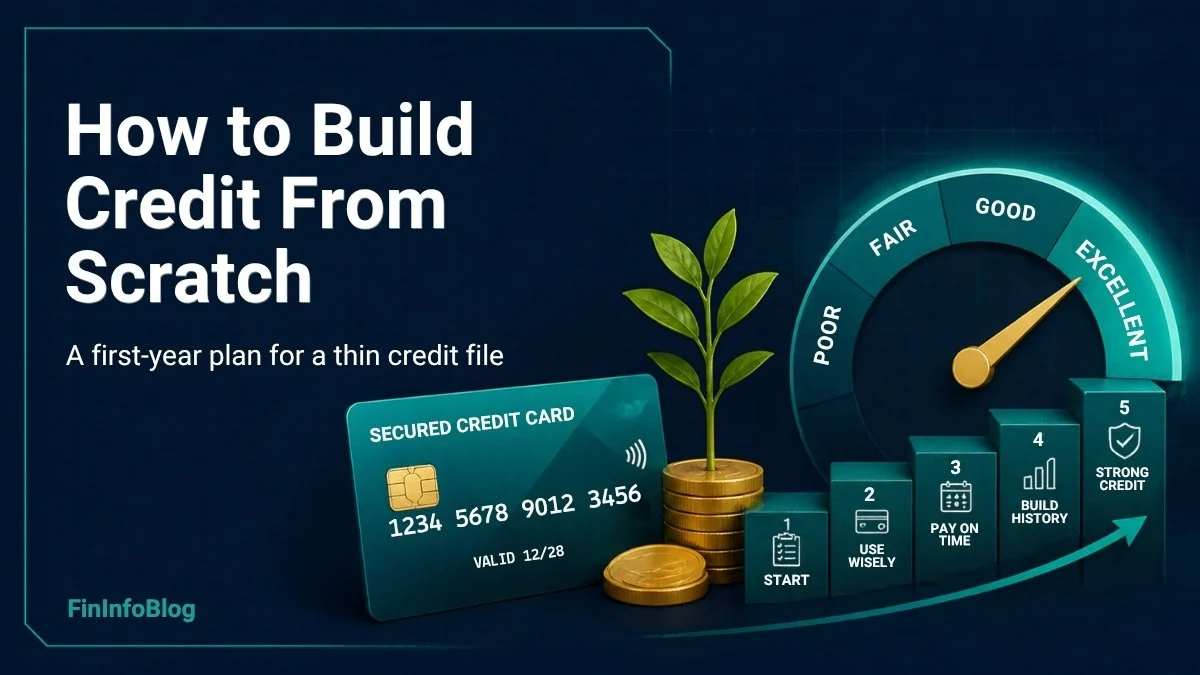
“I have no credit at all. Where do I even start?” Start with one account that reports to all three credit bureaus, use it lightly, and pay it in full every month. A secured credit card, a credit-builder loan or an authorized-user spot on a trusted relative’s card can each get you there. FICO says you generally need at least one account that has been reporting for six months or more before a FICO Score can be generated, so the first half-year is mostly about patience and perfect payments.
Key takeaways
- A FICO Score generally needs at least one account reporting for 6 months or more, so plan on about half a year before your first score.
- Payment history (35%) and amounts owed (30%) drive most of a FICO Score, so on-time payments and low balances matter from day one.
- Secured cards from major issuers can start with a $200 deposit and no annual fee (Capital One and Discover terms checked Nov. 17, 2026).
- Debit cards, prepaid cards and payday loans don’t build credit, because they aren’t reported to the nationwide bureaus as credit.
Having no credit history isn’t a mark against you the way late payments are. Lenders simply have nothing to judge. The Consumer Financial Protection Bureau’s corrected 2025 estimate puts “credit invisible” adults (no file at all at the three nationwide bureaus) at about 2.7% of U.S. adults as of 2020, and it says the correction moves many of the people once counted as invisible into the “unscored” group, whose files are too thin or too stale to score. If you’re new to the U.S., just out of school or have always paid cash, you may be in one of those groups.
This guide is about starting from zero. If you already have a score and want to raise it, our step-by-step guide to improving your credit score is the better fit.
How a credit file gets started
Your credit report is built from what lenders (called furnishers) send to Equifax, Experian and TransUnion. A file is opened the first time a lender reports an account in your name. A score comes later, once there’s enough data to model.
Two practical points follow from that:
- Pick products that report to all three bureaus. Lenders can check any one of them. Capital One and Discover both say their secured cards report to all three.
- The scoring clock starts at the first report. Opening several accounts at once doesn’t speed up the six-month requirement. It just adds hard inquiries and lowers your average account age. Our guide to how much a hard inquiry drops your score explains that trade-off.
Here’s what doesn’t count, according to the CFPB: debit card use, cash, prepaid cards and payday loans. Even on-time payday loan payments aren’t reported to the nationwide bureaus. And “buy here, pay here” car loans typically report the bad (late payments) but not the good.
Your four main ways to start
Rates and terms checked: Nov. 17, 2026. They change often, so confirm with the provider before you apply. How we rate banks
| Option | Typical cost | How it builds credit | Best for | Watch out for |
|---|---|---|---|---|
| Secured credit card | Refundable deposit (often $200+); many have no annual fee | Revolving account with on-time payments and utilization reported monthly | Most people starting out | High APRs if you carry a balance; some cards charge annual or monthly fees |
| Credit-builder loan | Interest and any fees; money is held in savings until paid off | Installment account with a payment history | People who want a forced savings plan, or a second account type | A late payment hurts just like any loan; check that the lender reports to all three bureaus |
| Authorized user | Usually free | The primary cardholder’s account history usually appears on your report too | Young adults with a family member who pays on time | Their late payments or high balances can show up on your report |
| Starter or store card | No deposit; low limits | Revolving account, like a secured card | People who can get approved without a deposit | Store cards often carry high APRs and work at one retailer only |
The CFPB lists secured cards, credit-builder loans and low-limit retail cards as ways to start. FICO adds becoming an authorized user, noting that the account activity “usually appears on both cardholders’ credit reports.”
Secured cards: two real examples
We checked these terms on each issuer’s own card page on Nov. 17, 2026. They’re examples, not a ranking. Terms change, so confirm them before you apply. Our card methodology explains how we evaluate cards.
| Card | Annual fee | Deposit | Purchase APR (variable) | Path to unsecured |
|---|---|---|---|---|
| Capital One Platinum Secured | $0 | $49, $99 or $200 minimum, based on creditworthiness, for a $200 starting line; deposit more (before activation) for a line up to $1,000 | 29.24% | May earn line increases without a new deposit; can earn the deposit back and upgrade with a positive track record |
| Discover it Secured | $0 | $200 minimum (line equals deposit), up to $2,500 based on income | 22.99% | Automatic monthly reviews starting at 8 months |
Notice the APRs. These cards are built to be paid in full. On a $200 balance at 22.99%, interest runs about $3.83 a month, which isn’t much in dollars but defeats the purpose. The win comes from the reporting, not from borrowing.
From the lending desk: In our team’s experience reviewing applications, a thin file with 12 months of perfect payments on one or two accounts is a much easier “yes” than a file with five new accounts opened in the same quarter. Underwriters read a burst of new accounts as a borrower who suddenly needs credit. One card, used lightly and paid every month, tells the opposite story. If you’re denied, ask for the adverse action notice and read the exact reason. “Insufficient credit history” means wait and keep paying, not apply somewhere else the next week.
A first-year plan, month by month
Month 0: Open one account
Choose a secured card (or a credit-builder loan from your bank or credit union) that reports to all three bureaus. Many credit unions offer credit-builder loans and small secured cards; our credit union guide explains how membership works. If you’re a student, pair this with a no-fee checking account from our best banks for students list so autopay has somewhere to pull from.
Months 1–6: Put one small bill on it
Move a single recurring charge to the card, such as a $15 streaming plan or a $25 phone add-on, and set autopay for the full statement balance. On a $200 limit, a $25 charge is 12.5% utilization when the statement closes. That’s fine; paying in full means no interest. Our credit utilization guide explains why low balances help and how statement dates affect what gets reported.
Month 6–7: Check your first score
Pull your free reports at AnnualCreditReport.com and confirm the account shows up correctly at all three bureaus. Many card issuers and banks show a free score in their apps. If an account is missing at one bureau, that’s not an error by itself, since lenders aren’t required to report to all three, but it’s worth asking the lender.
Months 8–12: Graduate, then add a second account type
Watch for an upgrade or line increase. Discover, for example, says it starts automatic reviews at 8 months. After a year of clean history, a second account, such as a credit-builder loan if you started with a card, adds an installment account to your mix. Credit mix is only about 10% of a FICO Score, so don’t take on debt you don’t need just for mix.
How a credit-builder loan works (with the math)
A credit-builder loan flips a normal loan around. The lender puts the loan amount in a locked savings account or CD, you make monthly payments, and you get the money when the loan is paid off. The CFPB says payments usually run over 6 to 24 months.
Example (illustrative rate): a $1,000 credit-builder loan at 6% APR for 12 months has a payment of about $86.07. Over the year you’d pay $1,032.80, so the credit history costs about $32.80 in interest, plus any fees the lender charges, and you’d end with $1,000 in savings. Some credit unions pay dividends on the held funds, which lowers the net cost. Ask for the APR and every fee in writing before you sign, and run the numbers in our loan calculator.
Other ways rent and bills can count
Rent and utility payments don’t show up on most credit reports unless someone reports them. A few options are worth knowing:
- Rent reporting: Some landlords and rent-reporting services send on-time rent to the bureaus. Check fees and which bureaus they report to before you sign up.
- Mortgage underwriting: Fannie Mae’s Desktop Underwriter can use 12 months of rent payments of $300 or more, found in bank statement data, for borrowers with no score or limited credit. Fannie Mae says it’s positive-only and doesn’t change your credit score itself. Our first-time homebuyer guide covers other programs.
Mistakes that slow you down
- Applying everywhere after one denial. Each application can mean another hard inquiry.
- Maxing out a small limit. A $190 balance on a $200 limit reports as 95% utilization, even if you pay it off days later.
- Closing your first card. Once it upgrades or you get a better card, keeping the oldest no-fee account open protects your account age.
- Paying for “credit repair” or “CPN” schemes. No one can legally give you a new credit identity. Our scam checker flags common credit-repair red flags, and our list of credit card mistakes covers the everyday ones.
- Co-signing for a friend. Their late payment becomes your late payment.
When you can expect to qualify for more
There’s no fixed timeline, but here’s a fair picture. After about six months you’ll usually have a score. After a year of on-time payments and low balances, unsecured starter cards and small credit union loans become realistic. Car loans and mortgages look at more than the score, including income, debt-to-income ratio and how long you’ve had credit. Our guide to how credit scores affect loan approval and rates shows why a longer, thicker file means better pricing, and how banks decide loan applications walks through the rest of the file a lender reviews.
Next step: pick one product from the table above, open it, set up autopay, and set a calendar reminder for six months from today to pull your reports.
Frequently asked questions
How long does it take to build credit from nothing?
FICO says you generally need at least one account that has been reporting for six months or more before a FICO Score can be generated. Getting from a first score to a strong one usually takes a year or more of on-time payments and low balances.
What is the fastest way to build credit with no credit history?
Becoming an authorized user on a relative’s long-standing, on-time card can add history quickly, because that account usually appears on your report too. Pair it with your own secured card so you’re building a record that’s yours.
Does a debit card build credit?
No. The CFPB notes that debit card and cash payments aren’t reported to the credit bureaus, so they don’t show that you can repay debt. Prepaid cards don’t build credit either.
Can I get a credit card with no credit history?
Often, yes. Secured cards are designed for it, and some issuers offer starter cards with low limits. Capital One’s Platinum Secured, for example, may ask for a $49, $99 or $200 deposit based on your creditworthiness (terms checked Nov. 17, 2026).
Is it better to have no credit or bad credit?
No credit is easier to fix. You only need time and on-time payments to build a file, while late payments and collections stay on your report for years. Use our credit utilization calculator to keep balances low from the start.
Sources: myFICO, “How can I start building my credit history?” (score requirement and 35%/30% weights); CFPB, “What are some ways to start or rebuild a good credit history?” (Sept. 13, 2024) and “Technical correction and update to the CFPB’s credit invisibles estimate” (June 23, 2025); Capital One Platinum Secured and Discover it Secured card pages (terms checked Nov. 17, 2026); Fannie Mae, Positive Rent Payment History in DU FAQs. This article is for educational purposes and isn’t financial advice.

Written by Chanchala
Founder & Lead Writer · B.Sc. Mathematics (Honors) · 9 years in banking & lending
Chanchala is the founder and lead writer of FinInfoBlog. She holds a B.Sc. in Mathematics (Honors) and has 9 years of experience in banking and lending. She writes plain-English guides on savings, CDs, loans, credit and personal finance for U.S. readers, and makes sure every example shows the math behind the money decision. How we research and fact-check.