
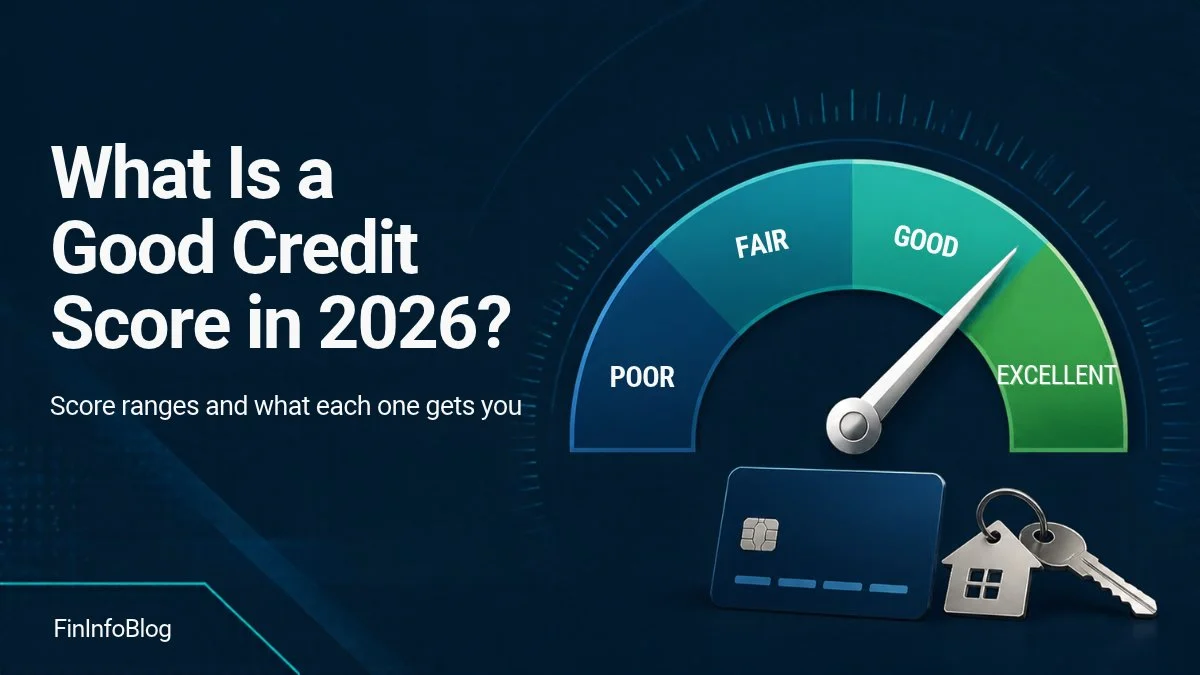
The average FICO Score in the U.S. is 714, according to FICO’s own Credit Insights report released in August 2026, and it has barely moved since late 2025. That number is a useful anchor, because most lenders treat anything from the high 600s up as “good” credit. But “good” isn’t one number. It depends on the scoring model the lender pulls and on what you’re applying for.
Here’s the short version: on the FICO scale, a score of 670 to 739 is good, 740 to 799 is very good and 800 or higher is exceptional. For most loans, 740 is where the best pricing starts to open up. Below, you’ll see the full ranges for both FICO and VantageScore, the minimums that government mortgage programs actually publish, and a dollar example of what moving up one band can save you.
Key takeaways
- FICO’s “good” range is 670–739; VantageScore calls 661–780 “prime.”
- The national average FICO Score is 714 (FICO, data through April 2026).
- FHA lets you put 3.5% down with a 580 score; VA sets no minimum score of its own.
- On a $400,000 Fannie Mae purchase loan at 80% LTV, the upfront price adjustment is $1,500 at 780+ vs. $7,000 at 680–699.
Credit score ranges: FICO vs. VantageScore
Both major scoring models use a 300 to 850 scale, but they slice it differently. FICO uses five named bands. VantageScore uses four lending tiers. The share of Americans in each band below comes from Experian, one of the three credit bureaus, in data it published in December 2024.
Rates and terms checked: Nov. 18, 2026. They change often, so confirm with the provider before you apply. How we rate banks
| FICO Score 8 range | FICO label | Share of Americans | What it usually means for you |
|---|---|---|---|
| 800–850 | Exceptional | 22% | Top pricing on nearly every product; little left to gain |
| 740–799 | Very good | 28% | Best or near-best mortgage and auto pricing |
| 670–739 | Good | 21% | Approved for most loans and cards, at somewhat higher rates |
| 580–669 | Fair | 16% | Approval possible, but expect higher APRs, fees or a cosigner |
| 300–579 | Poor | 13% | Many lenders decline; secured cards and credit-builder loans are the path back |
| VantageScore 3.0/4.0 range | Tier | Share of Americans |
|---|---|---|
| 781–850 | Super prime | 31% |
| 661–780 | Prime | 33% |
| 601–660 | Near prime | 17% |
| 300–600 | Subprime | 18% |
Notice the overlap. A 700 is solidly “good” on FICO and “prime” on VantageScore, so most lenders will see you the same way. The edges are where it gets tricky: a 665 is “fair” on FICO but “prime” on VantageScore, which is one reason the score in your banking app may look better than the one a lender quotes.
Why your “good” score might not match the lender’s
The Consumer Financial Protection Bureau puts it plainly: you don’t have one credit score. Your number varies with the scoring model, the type of loan it’s built for, which bureau’s data it uses and the day it’s calculated. A few practical consequences:
- Free scores are often VantageScore. Many apps and card issuers show VantageScore 3.0 or 4.0, while many lenders still pull a FICO version.
- Mortgages use their own models. Fannie Mae and Freddie Mac have long relied on older “Classic FICO” versions. Since April 22, 2026, when the FHFA and HUD announced the change, approved lenders can also use VantageScore 4.0, and FICO Score 10T is being added later. FHA is permitting both new models, too.
- Auto and card lenders may use industry scores. FICO Auto and Bankcard scores run on a wider 250–900 scale, so a “good” number there can look different.
- Each bureau can hold different data. If a lender reports only to Experian, your Equifax-based score won’t reflect that account.
So treat the bands as a guide, not a guarantee. If you’re within 10–20 points of a cutoff, assume you could land on either side depending on which score is pulled.
What’s a good credit score for each type of loan?
Here’s what the rule-makers themselves publish. Where an agency or issuer doesn’t set a hard number, we say so rather than guess.
| Product | Published minimum or rule | Score that tends to get better pricing | Source |
|---|---|---|---|
| FHA mortgage | 580+ for 3.5% down; 500–579 needs at least 10% down | Lenders often add their own higher floor (“overlay”) | HUD |
| VA mortgage | No VA minimum; the lender may set one | VA purchase applicants averaged 721 (2023) | VA Loan Guaranty Service |
| Conventional (Fannie Mae) | No minimum score for loans run through Desktop Underwriter since Nov. 2025; manual underwriting still uses score floors | 780+ gets the smallest price adjustments; 740 is a key break point | Fannie Mae Selling Guide and LLPA matrix |
| Credit cards | Issuers rarely publish a score; they describe credit levels instead | “Excellent” at Capital One means no bankruptcy or default, no 60-day lates in a year, and 3+ years with a $5,000+ limit | Capital One credit level guidelines |
| Auto loans and personal loans | Set lender by lender | Rates step down noticeably at each tier; see our auto and personal loan guides | Lenders’ own pages |
The Capital One example is worth a second look. Its “excellent” tier isn’t defined by a score at all. It’s defined by behavior: no recent serious lates, a few years of history and a meaningful credit line. That’s a good reminder that lenders read the report behind the number. Our guide to how banks decide loan applications walks through everything else they weigh, and how credit scores affect loan approval and rates shows rate gaps by tier for mortgages, auto loans and personal loans. For cars specifically, see what credit score you need for a car loan.
What a higher band is worth: a mortgage example
Fannie Mae publishes a grid of loan-level price adjustments (LLPAs). These are upfront charges, set by credit score and loan-to-value ratio, that lenders either collect at closing or build into your interest rate. Here’s what the grid (updated Sept. 9, 2026) means for a $400,000 purchase loan on a $500,000 home (80% LTV, 30-year term):
| Classic FICO score | LLPA at 75.01–80% LTV | Cost on a $400,000 loan |
|---|---|---|
| 780 or higher | 0.375% | $1,500 |
| 740–759 | 0.875% | $3,500 |
| 720–739 | 1.250% | $5,000 |
| 680–699 | 1.750% | $7,000 |
| 640–659 | 2.250% | $9,000 |
The jump that surprises people is the one at 740. Moving from 739 to 740 cuts the adjustment from 1.25% to 0.875%, which is $1,500 on this loan for one point. And a borrower at 680–699 pays $5,500 more upfront than someone at 780+, before any difference in rate. Not every lender passes these costs through the same way, and other add-ons can apply, but the direction is always the same: higher score, lower price.
From the lending desk: In our team’s experience reviewing mortgage files, the score that decides pricing is usually the middle of your three bureau scores, and when two people apply together, lenders often price off the lower of the two middle scores. Borrowers often quote their highest app score and are caught off guard. If you’re a few points under 740 or 720, ask the loan officer whether a rapid rescore after paying down a card balance is worth it before you lock your rate.
Is 650, 700 or 750 a good credit score?
These are the scores people ask about most, so here’s a straight read on each (FICO scale):
- 600–649: Fair. You can likely get an FHA loan and some cards, but you’ll pay more. Your first goal is clearing any recent late payments and getting card balances down.
- 650–669: High fair, right under the “good” line. A modest drop in your credit utilization ratio may be enough to cross 670.
- 700: Good, and a little below the 714 national average. Approval odds are solid; pricing improves as you climb toward 740.
- 750: Very good. You’re in or near the best-rate territory for most auto loans and cards; for mortgages, 780 still trims costs a bit further.
- 800+: Exceptional. Extra points beyond here rarely change your rate, so focus on keeping your habits steady rather than chasing 850.
How to move up a band
Scores move in predictable ways. Payment history (35% of a FICO score) and amounts owed (30%) do most of the work, so start there:
- Check all three reports free at AnnualCreditReport.com and fix real errors. Our guide to removing a late payment from your credit report covers disputes and goodwill letters.
- Pay balances before the statement date so a lower balance is reported. Try our credit utilization calculator to see how much to pay.
- Space out applications. One hard inquiry usually costs a few points for a short time; see how many points a hard inquiry drops your score.
- Keep older accounts open to protect your average age of accounts and your total available credit.
- Starting with no score? Follow our plan to build credit from scratch.
For the full step-by-step plan, read how to improve your credit score. If you’ve already been turned down, the loan denial decoder explains what the reasons on your adverse action notice mean.
Common mistake: Waiting to “check your score” until you apply. Look at your reports two to three months before a big application, so you have time to pay down balances and correct errors before the lender pulls your credit.
Frequently asked questions
What is a good credit score to buy a house in 2026?
You can qualify for an FHA loan with 580 (3.5% down), and Fannie Mae no longer sets a minimum score for loans approved through its Desktop Underwriter system. For the lowest costs on a conventional loan, aim for 740 or higher; Fannie Mae’s price adjustments shrink again at 760 and 780.
Is 714 a good credit score?
Yes. 714 is in FICO’s “good” range (670–739) and matches the national average FICO Score in FICO’s August 2026 report. You’ll be approved for most products, and raising it past 740 can lower your borrowing costs.
Why is my credit score different on my credit app than what the lender saw?
The free score you see may be a VantageScore built on one bureau’s data, while the lender may pull a FICO version from all three bureaus. Different models and different data can produce noticeably different numbers on the same day.
What credit score do you start with?
You don’t start at zero or at 300. You have no score until you have enough credit history; FICO needs at least one account open for six months and one reported in the last six months. Your first score depends on how those first accounts are handled.
Is a 900 credit score possible?
Not on the main FICO or VantageScore models, which top out at 850. Some industry-specific FICO scores for auto loans and credit cards run up to 900.
Sources: FICO, “FICO Score Credit Insights Report” (Aug. 25, 2026; scores Oct. 2025–April 2026); Experian credit score range distribution (Dec. 18, 2024); CFPB, “What is a credit score?” (reviewed Sept. 2, 2026); FHFA/HUD news release on VantageScore 4.0 and FICO 10T (April 22, 2026); HUD FHA credit score policy (580/10% down); VA Loan Guaranty Service quick reference (no VA minimum; 2023 average 721); Fannie Mae LLPA matrix (updated Sept. 9, 2026) and Selling Guide update removing the DU minimum score (Nov. 2025); Capital One credit level guidelines (checked Nov. 18, 2026); myFICO scoring factor weights. This article is for educational purposes and isn’t financial advice.

Written by Chanchala
Founder & Lead Writer · B.Sc. Mathematics (Honors) · 9 years in banking & lending
Chanchala is the founder and lead writer of FinInfoBlog. She holds a B.Sc. in Mathematics (Honors) and has 9 years of experience in banking and lending. She writes plain-English guides on savings, CDs, loans, credit and personal finance for U.S. readers, and makes sure every example shows the math behind the money decision. How we research and fact-check.